Tenant Council / Board Election
- niviankraft
- Jan 28
- 3 min read
Updated: Feb 7
Our Elected Tenant Board
Kawailehua Community Alliance
The Kawailehua Tenant Board is a fully elected, resident-led governing body established to ensure tenants have a real voice, a functional grievance process, and coordinated systems of safety, care, and accountability.
This board exists because residents organized—persistently and lawfully—despite significant institutional hurdles. Today, Kawailehua stands as the only public housing community in the State of Hawaiʻi with an elected tenant board across all public housing projects. The challenges it took to reach this point help explain why so few tenant boards or intact neighborhood watches exist statewide.
This work is grounded in Hawaiian values: Moʻolelo, ʻIke, Hana, Pono, Mālama, and Kuleana.
Elected Board Members & Roles
President & Communications Lead
Nivian Magdalene Kraft
Nivian Kraft was elected President to coordinate services, improve communication, and help establish systems where safety concerns and grievances are taken seriously and followed through on.
Her family has lived at Kawailehua for three years. She grew up in Kapaʻa, spent twenty years on the mainland, and returned home to Kauaʻi with experience in housing advocacy, community organizing, and service-based leadership. She considers it her kuleana to share these skills with her community.
Nivian also brings over eighteen years of experience as a children’s magician, author, and family event producer, grounding her leadership in gathering, play, and care for keiki.
As President, she:
Facilitates meetings and shared decision-making
Serves as a primary liaison with partners and agencies
Oversees communications and tenant updates
Supports documentation, compliance, and continuity
Vice President & Chair of the Safety Committee
Michael Gurr - Resigned 2-5-26 Do to FEAR of Manager & Criminals Retaliation.
Michael Gurr was elected Vice President and Chair of the Safety Committee. He has lived on Kauaʻi since 2005 and in public housing since 2011.
Immigrant Ambassador Aunty / Interm VP /Treasurer Liaison
Christy Fujimori
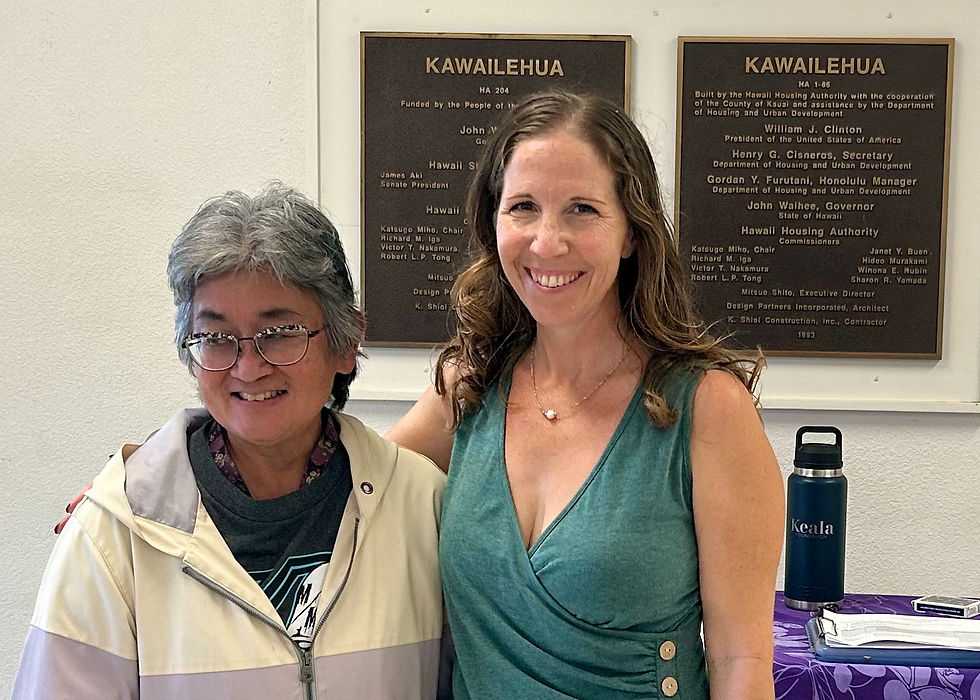
Christy Fujimori was elected to serve as Immigrant Ambassador Aunty and Treasurer Liaison. She has lived in this community for 25 years and raised two children here in Kōloa.
Christy is an ELA teacher at Kōloa Elementary School and has long supported immigrant families through language access, cultural understanding, and trust-based connection. She brings a calm, steady presence and deep relational knowledge of the community.
In her role, Christy:
Supports immigrant and multicultural engagement
Bridges communication with families who may face language or cultural barriers
Serves as a Treasurer Liaison, working with fiscal partners and the board to ensure transparency and accountability
Christy is supported in cultural and health-bridging work by community partners, including Marshallese and Micronesian advocates and community health workers.
Treasurer & Fiscal Structure
Treasury oversight is handled collaboratively by Nivian Kraft and Christy Fujimori as Treasurer Liaisons. They work directly with fiscal partners to ensure compliance, transparency, and proper stewardship of funds.
Current and future fiscal structure includes:
Kauaʻi Community Planning Alliance as a fiscal partner
Kawailehua Community Alliance, which is in the process of filing for 501(c)(3) status
This structure allows the board to operate responsibly while building toward long-term sustainability.
A Flexible, Growing Governance Model
This board structure is a solid starting foundation, not a fixed endpoint. As capacity and participation grow, the Tenant Board may:
Add additional committees
Expand board seats (up to seven total)
Adjust roles to better meet community needs
This flexibility is intentional and aligns with best practices for resident-led governance.
The Reality of Organizing in Hawaiʻi Public Housing
Reaching this point required extraordinary persistence. Nivian Kraft documented dozens of calls, emails, and follow-ups at nearly every step—work that should not be required if systems functioned as intended and agencies coordinated appropriately.
At one critical point, Luke Evslyn made a direct effort to contact Oʻahu-based Hawaiʻi Public Housing Authority leadership to prompt a response after local management on Kauaʻi obstructed the community’s federally protected right to organize.
Beyond that intervention, no sustained responses have been received from elected representatives regarding repeated requests for support in:
Coordinating a safety plan with KPD
Educating district representatives on public housing governance
Addressing legal and dignity-based liabilities currently impacting residents
As of today, communication from Mel Rapozo, Fern Holland, and other elected officials has ceased, despite ongoing requests for engagement.
These gaps underscore why tenant-led governance is not only justified—but necessary.
*HUD / HPHA Tenant Board rules know that this demographic is fearful of speaking up. We know we will get more board members as the tenants start to see evidence that this is real, by taking back our community room which has been used as storage for years by management.


Comments